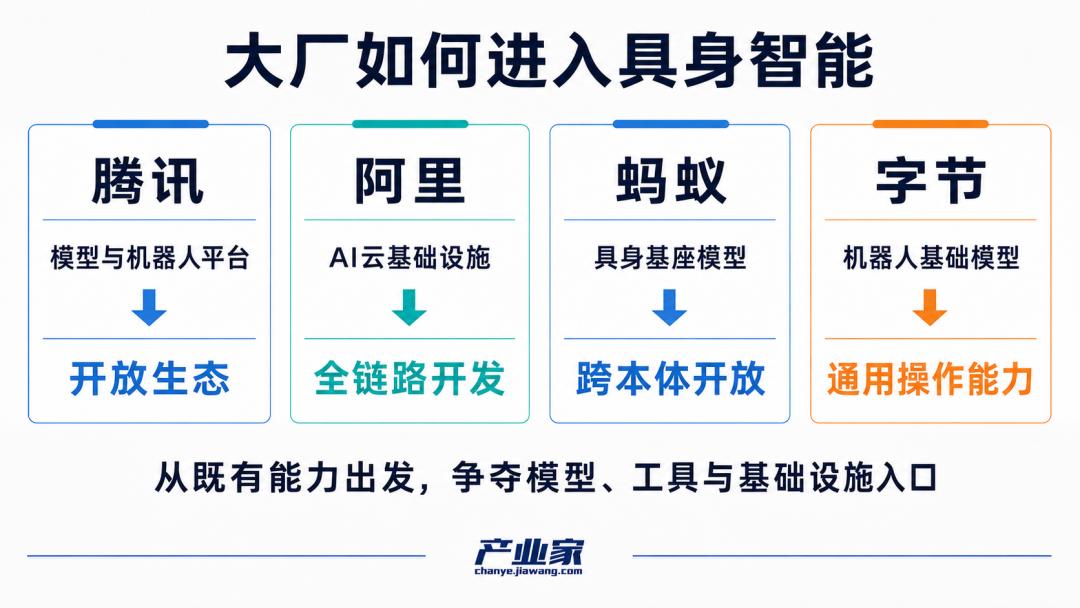
具身智能产业中的核心技术竞争正在升温。1蚂蚁集团旗下蚂蚁灵波科技于7月8日宣布全面开源具身基座模型LingBot-VLA 2.0,1腾讯同步开源混元3D世界模型2.0,1阿里则与英伟达在Physical AI领域达成合作。1大厂通过开源具身基座模型、VLA模型等方式,试图建立数据-模型-部署的闭环。1与此同时,独角兽企业也在积极布局,自变量与顺丰、金杯股份达成合作,1银河通用与博原资本设立合资公司,17月24日宇树科技与成都市达成战略合作。1
大厂与独角兽的竞争策略存在差异。1大厂采取"修路"策略出售算力和工具链,独角兽则分别押注通用平台和场景复制两条路径。1然而,具身智能的商业化进程仍面临多重瓶颈。1产业缺乏统一的计量方式,1数据流动、成本竞争等问题待解。1企业客户在部署时需要权衡环境改造成本与机器人智能成本。1
Major technology companies and startups are intensifying their competition to establish dominance in the embodied intelligence sector through open-sourcing foundational models and development tools. On July 8, Ant Group's subsidiary Ant Lingbo Technology announced the full open-source release of its embodied foundation model LingBot-VLA 2.0 1. This move reflects a broader industry strategy to build a closed-loop ecosystem spanning data collection, model development, and deployment.
The competitive landscape extends across multiple players pursuing different strategies. Tencent has open-sourced its Hunyuan 3D World Model 2.0, while Alibaba has entered a collaboration with NVIDIA in the Physical AI domain 1. Among emerging unicorn companies, Zibianiang has partnered with SF Express and Golden Cup Holdings, while Galaxy General Intelligence has established a joint venture with Boruán Capital 1. Additionally, Unitree Technology signed a strategic cooperation agreement with Chengdu City on July 24 1.
However, the sector faces significant commercial hurdles that could determine the viability of these platforms. The embodied intelligence industry has yet to develop a standardized measurement system—described as lacking its own "Token"—creating uncertainty around pricing and value assessment 1. Enterprises face a critical trade-off between the costs of environmental modification and the intelligence capabilities of robots themselves 1, a calculation that will ultimately determine market adoption rates and the success of competing infrastructure platforms.
评论
还没有评论,欢迎留下第一条。