中央气象台预报显示,自22日起将有冷空气影响我国中东部地区 1。此次过程将导致大部地区气温下降4~8℃,局地降温达10℃,并伴随大风及雨雪天气 1。专家提醒公众注意防寒保暖,警惕强降雪对交通和畜牧业的影响 1。
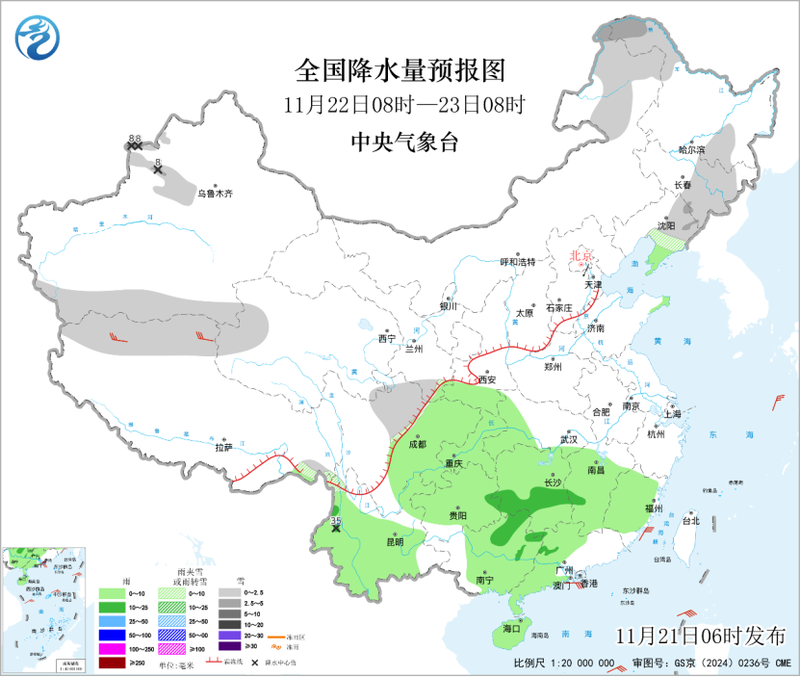
风力方面,相关区域伴有46级大风,阵风710级 1。降水分布上,内蒙古东部、东北地区有小到中雪;吉林东部部分地区有中到大雪,局地暴雪;西南地区东部、江南及华南大部有小到中雨 1。此外,23-24日,西藏中东部、川西高原、云南北部等地部分区域有中到大雪,局地暴雪 1。
针对干燥多风的天气条件,北京北部、河北东北部、内蒙古东南部、辽宁西部、四川西部、云南西北部部分地区森林火险气象等级较高 1。相关部门提示需在干燥多风期间加强森林草原防火意识 1。
The National Meteorological Center has issued a forecast indicating that a cold air mass will begin affecting central and eastern regions of China starting on the 22nd 1. This weather process is expected to cause temperatures across most of these areas to drop by 4 to 8 degrees Celsius, with local decreases reaching up to 10 degrees 1. In addition to the significant cooling, the region will experience winds of force 4 to 6, with gusts potentially reaching force 7 to 10 1.
Precipitation patterns will vary across different parts of the country during this period. Light to moderate snow is predicted for eastern Inner Mongolia and Northeast China, while some areas in eastern Jilin Province may see moderate to heavy snow, with localized blizzard conditions 1. Meanwhile, light to moderate rain is expected in eastern Southwest China, Jiangnan, and most of South China 1. Looking ahead to January 23 and 24, parts of central-eastern Tibet, the western Sichuan Plateau, and northern Yunnan are also forecast to receive moderate to heavy snow, including localized blizzards 1.
Experts advise the public to take precautions against the cold and remain vigilant regarding the impact of heavy snow on transportation and livestock farming 1. Furthermore, due to the dry and windy conditions, there is an increased risk of forest and grassland fires in several specific regions, including northern Beijing, northeastern Hebei, southeastern Inner Mongolia, western Liaoning, western Sichuan, and northwestern Yunnan, where meteorological fire danger levels are rated as high 1.
评论
还没有评论,欢迎留下第一条。