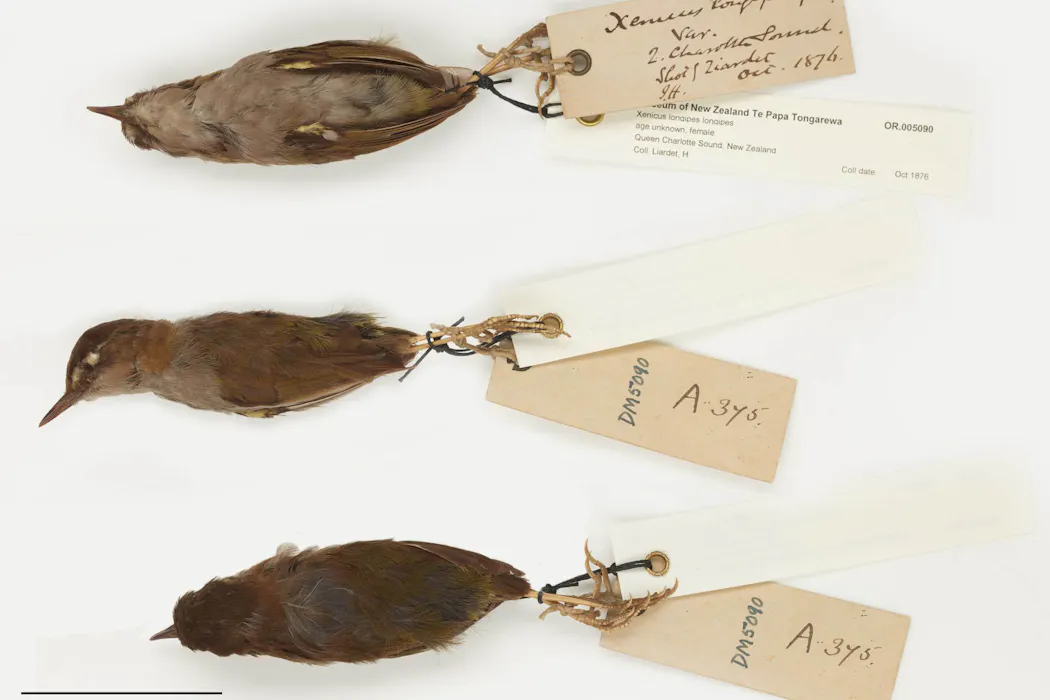
一项基于博物馆标本古DNA分析的新研究,重构了已灭绝的新西兰鹪鹩(Bush Wrens)的演化与生态历史 1。研究发现,鹪鹩科鸟类约在六百万年前因南阿尔卑斯山隆起而开始演化,并在过去258万年间的冰河时期气候循环驱动下发生多样化 1。北岛和南岛的鹪鹩种群约在260万年前分化,建议将其视为独立物种而非亚种 1。此外,该研究确认了一个此前未被识别、隐藏在普通外观下的新亚种——托塔拉努伊鹪鹩(Tōtaranui bush wren, Xenicus longipes perditus) 1。
斯蒂德鹪鹩(Stead’s bush wren / mātuhituhi)是新西兰最后灭绝的鸟类,约于1972年在Taukihepa Big South Cape岛消失 1。其灭绝的直接原因是约1963年随渔船引入该岛的褐鼠 1。褐鼠的入侵不仅导致斯蒂德鹪鹩灭绝,还造成了斯图尔特岛沙锥和短尾蝙蝠的灭绝,并使南岛鞍背鸦濒临灭绝 1。文章作者Nic Rawlence和Alexander Verry指出,这一教训强调了保护遗传多样性和生态系统气候韧性的重要性 1。该研究受Royal Society Te Apārangi Marsden Fund资助 1。
A new study utilizing ancient DNA analysis from museum specimens has revealed the evolutionary history of the now-extinct bush wrens in New Zealand, highlighting critical lessons for current conservation efforts 1. The research confirms that Stead’s bush wren (mātuhituhi), the last of its kind to disappear, went extinct around 1972 on Taukihepa Big South Cape Island following the arrival of brown rats 1. These invasive rodents were introduced to the island approximately 1963 via fishing vessels, an event that also drove the extinction of the Stewart Island snipe and short-tailed bat, while pushing the South Island saddleback to the brink of disappearance 1. This ecological collapse underscores the urgent need to preserve genetic diversity and maintain ecosystem resilience against climate change 1.
Beyond the tragic story of their extinction, the study uncovers significant evolutionary details about the bird family. Analysis suggests that bush wrens began evolving roughly six million years ago, driven by the uplift of the Southern Alps 1. Their subsequent diversification was closely linked to glacial climate cycles over the past 2.58 million years 1. The findings indicate that populations on the North and South Islands diverged approximately 2.6 million years ago, leading researchers to recommend classifying them as distinct species rather than subspecies 1. Additionally, the genomic data identified a previously unrecognized subspecies hidden within the common appearance of the birds: the Tōtaranui bush wren (Xenicus longipes perditus) 1. The research, authored by Nic Rawlence and Alexander Verry, was funded by the Royal Society Te Apārangi Marsden Fund 1.
评论
还没有评论,欢迎留下第一条。