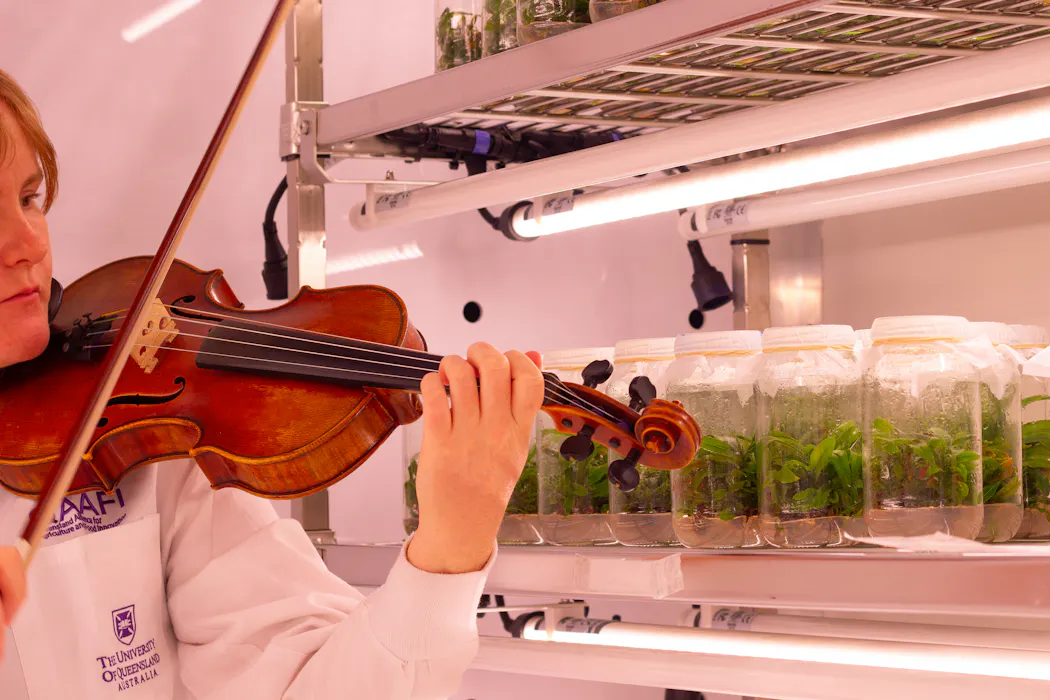
关于音乐对植物生长的影响,长期存在的科学疑问一直缺乏严谨的证据支撑。11973年,音乐系学生Dorothy Retallack出版了《The Sound of Music and Plants》一书,声称摇滚乐会导致植物死亡,而古典音乐则能促进其繁荣。1然而,Retallack的研究因方法不严谨且未经同行评审而遭到科学界强烈批评。1
从科学角度看,植物确实能够通过物理方式感知声波。1研究发现,声波与植物结构(如叶毛)会相互作用,某些植物甚至会朝向流水声生长,某些植物在听到昆虫捕食声后会改善其防御反应。1然而,科学共识认为,植物无法区分定义音乐类型的微妙差异。1因此,测试不同音乐类型对植物生长的差异化效果的研究本质上存在偏差。1
The question of whether music influences plant growth has captivated scientific curiosity for decades, though the evidence remains far more complicated than popular belief suggests. A landmark 1973 study by Dorothy Retallack claimed that rock music caused plants to wither while classical music promoted their flourishing, but this research suffered from significant methodological flaws and was never subjected to peer review, drawing strong criticism from the scientific community.1 Retallack, a music student with minimal scientific training, lacked the rigorous experimental design necessary to support such dramatic conclusions.1
Modern science reveals that while plants can physically sense sound waves through interactions with structures like leaf hairs, they lack the capacity to distinguish the subtle differences that define different music genres.1 Research has demonstrated that plants may respond to specific natural sounds—some species grow toward the sound of flowing water, and certain plants exhibit improved defensive responses when exposed to the sounds of insect predation.1 However, the notion that different musical styles produce measurably different effects on plant growth is fundamentally flawed by inherent bias, as plants cannot differentiate between rock and classical compositions.1
评论
还没有评论,欢迎留下第一条。